
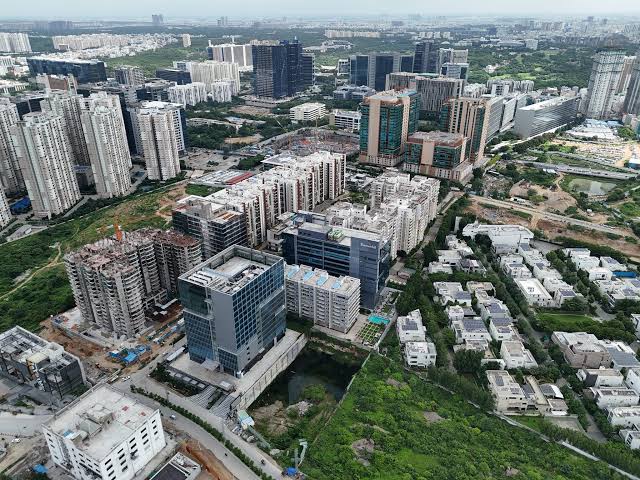
Hyderabad · West
Financial District
Hyderabad’s Global Business & Employment Core
A mature western Hyderabad business district where corporate employment, Grade-A offices, premium housing, hospitality and metropolitan infrastructure converge.
Our view on Financial District.
Hyderabad's Financial District is one of the city's most important employment and commercial centres.
Located within the western growth corridor, the district has evolved into a major concentration of:
Global technology companies
IT and IT-enabled services
Corporate offices
Grade-A commercial developments
Premium residential communities
Hotels and hospitality
Retail and urban services
Its significance extends well beyond the boundaries of the locality itself.
The Financial District acts as an economic engine for a much larger western Hyderabad residential market, supporting demand across:
Nanakramguda → Gachibowli → Narsingi → Kokapet → Tellapur → Kollur
This makes Financial District fundamentally different from a conventional residential market.
Its primary driver is:
Employment.
Real estate follows.
Why Financial District Matters
Real estate markets are ultimately influenced by economic activity.
Financial District represents one of Hyderabad's clearest examples of that relationship.
A concentration of major employers creates:
Jobs → employees → housing demand → retail demand → hospitality → services → infrastructure → further investment
This economic cycle gives the district a deeper demand foundation than locations whose investment thesis depends primarily on future infrastructure.
For WENS, this makes Financial District a core economic market, not merely a property market.
The Western Employment Corridor
Financial District sits at the centre of a broader employment ecosystem.
Core
Financial District
Nanakramguda
Gachibowli
↓
Premium Residential
Kokapet
Narsingi
↓
Residential Expansion
Tellapur
Kollur
Osman Nagar
↓
Lower-Density Western Markets
Mokila
Shankarpally
This relationship is fundamental to understanding western Hyderabad.
A large part of the residential growth taking place across this geography is ultimately supported by access to the employment centres around Financial District and Gachibowli.
Employment Engine
The Financial District has attracted a substantial concentration of multinational corporations, technology companies and other businesses.
The presence of these employers generates several layers of real-estate demand.
Primary Demand
Office space for companies and institutions.
Secondary Demand
Housing for employees and management.
Tertiary Demand
Retail, hospitality, restaurants, healthcare, education, transport and other services.
This creates a diversified urban ecosystem.
It also means that Financial District's real-estate performance should be analysed through employment and business activity, not residential launches alone.
Commercial Real Estate
Commercial development is the defining asset class of the Financial District.
The market contains substantial Grade-A office inventory and continues to attract corporate occupiers.
Demand is supported by Hyderabad's broader technology and services economy.
For commercial investors, important considerations include:
Occupancy
Rental levels
Tenant quality
Lease duration
Building quality
Micro-location
Parking
Access
Infrastructure
Vacancy
Future competing supply
A prestigious address does not automatically mean every commercial asset will perform equally.
WENS therefore evaluates commercial opportunities at the building and micro-market level.
Residential Market
Although Financial District is fundamentally an employment market, residential development has become an important part of its ecosystem.
The residential market includes:
Premium apartments
Luxury apartments
High-rise communities
Serviced residences
Rental housing
Gated developments in surrounding areas
Residential demand is closely connected to proximity to employment.
This creates an important distinction from peripheral investment markets.
A large part of the demand is supported by actual economic activity already taking place in the area.
Rental Market
The employment concentration creates a structural base for rental demand.
Potential tenants include:
Corporate professionals
Technology employees
Senior executives
Expatriate employees
Short- and medium-term corporate occupants
Families working within the western employment corridor
Rental demand is strongest where the combination of:
location + commute + housing quality + services
is competitive.
However, rental performance varies substantially by property.
WENS therefore does not apply a single rental yield assumption across the entire Financial District.
Connectivity
Outer Ring Road
The ORR is one of the Financial District's most important regional connectivity assets.
It connects the district to:
Airport
Shamshabad
Kokapet
Narsingi
Tellapur
Northern Hyderabad
Eastern Hyderabad
Other major employment corridors
This regional accessibility strengthens the district's position as a metropolitan business centre.
Internal Road Network
The district's rapid development has increased pressure on local roads and junctions.
As office and residential density increases, the quality of internal mobility becomes increasingly important.
WENS therefore distinguishes between:
regional connectivity
and
last-mile accessibility.
A project may be close to the Financial District geographically while still experiencing materially different practical travel times depending on road access and peak-hour congestion.
Public Transport
Improved mass-transit connectivity remains an important long-term factor for the western business corridor.
However, WENS separates:
operational transport
from
approved / planned transport
and from
proposed infrastructure.
Future metro or other mass-transit proposals should not be treated as existing connectivity until implementation reaches a meaningful stage.
This is particularly important in a mature market where future infrastructure expectations can already influence property pricing.
Hospitality & Urban Services
The Financial District's corporate ecosystem supports substantial demand for:
Business hotels
Serviced accommodation
Restaurants
Cafés
Retail
Corporate services
Healthcare
Fitness and lifestyle services
This creates an increasingly complete urban environment.
As the district matures, the real-estate opportunity expands beyond conventional office and apartment development.
Land Market
Vacant development land within the core Financial District is significantly more constrained than in emerging western corridors.
Consequently, land opportunities are increasingly associated with:
Redevelopment
Assembly
Underutilised parcels
Development partnerships
Commercial redevelopment
Mixed-use opportunities
Adjacent growth pockets
This changes the nature of the land-investment thesis.
The question is no longer simply:
“How much land is available?”
It becomes:
“What can this specific parcel legally and economically support?”
Development Economics
High land values within the Financial District create strong pressure on development economics.
Successful development increasingly depends on:
Permissible development intensity
Floor-area potential
Construction cost
Financing cost
Absorption
Rental levels
Capital values
Parking
Infrastructure
Tenant demand
A high land price can be justified when the development potential and demand support it.
It becomes a risk when land is acquired on the assumption that future prices alone will compensate for weak project economics.
This is an important area where WENS can add value.
Competitive Landscape
Financial District competes and interacts with other major western business locations, including:
Gachibowli
Nanakramguda
Kokapet
Raidurg
Madhapur
HITEC City
However, these locations are not interchangeable.
Each has different:
Office stock
Land availability
Tenant profiles
Residential supply
Connectivity
Development intensity
Pricing
WENS therefore evaluates Financial District as part of the larger western Hyderabad economic system, rather than comparing it purely on locality-wide property prices.
Infrastructure Status
Operational
Outer Ring Road
Provides established metropolitan connectivity.
Major employment and office ecosystem
Financial District is already an established corporate and employment centre.
Commercial and residential infrastructure
Significant office, residential, hospitality and supporting urban infrastructure is already operational.
Developing
Local infrastructure and urban capacity
Roads, junctions, utilities, public services and supporting amenities continue to evolve in response to increasing density.
Future / Potential
Further public-transport and metropolitan connectivity improvements could strengthen the western business corridor.
WENS does not treat future infrastructure as an operational advantage until implementation supports that classification.
What WENS Is Watching
1. Office absorption
Is demand for commercial space continuing to support new supply?
2. Employment growth
Are new jobs continuing to expand the underlying demand base?
3. Corporate occupier quality
Which companies and industries are driving demand?
4. Residential rental demand
Is housing demand keeping pace with employment growth?
5. Traffic & mobility
Can road infrastructure support increasing employment and residential density?
6. Commercial supply
How much new Grade-A office inventory is entering the western corridor?
7. Mixed-use development
Will the district become increasingly self-contained as an urban ecosystem?
8. Public transport
How will future mass-transit connectivity affect commuting patterns?
Key Risks
Despite its strong economic foundation, Financial District has its own risks.
Investors should consider:
High land values
High entry prices
Office supply cycles
Corporate leasing cycles
Concentration in technology and services
Traffic congestion
Infrastructure capacity
High development costs
Competition from other business districts
Project-specific execution risk
Potential mismatch between asking prices and transaction economics
The key risk is not whether Financial District has an economic base.
It clearly does.
The question is whether a particular asset has been acquired at a price that remains supported by its underlying economics.
Commercial Due Diligence
For commercial real estate in Financial District, WENS recommends evaluating:
Tenant profile
Lease structure
Occupancy
WALE / lease duration
Rental escalation
Vacancy
Building quality
Parking
Operating costs
Capital expenditure
Micro-location
Competing supply
Development pipeline
Exit liquidity
For investors, headline rental income should always be evaluated against the actual net operating economics of the asset.
Residential Due Diligence
For residential opportunities, WENS evaluates:
Developer track record
Project location
Unit configuration
Price relative to competing projects
Construction progress
Possession
Occupancy
Rental demand
Maintenance costs
Resale liquidity
Future competing supply
The strongest residential opportunities are not necessarily the most expensive projects.
They are those where price, quality, location and demand are aligned.
WENS Opportunity Framework
Financial District is particularly suited to an income and economic-activity-based analysis.
WENS evaluates opportunities through:
Economic Driver
Who creates the demand?
Asset
What exactly is being acquired?
Cash Flow
What income can the asset realistically generate?
Development Potential
What can legally and economically be built?
Competition
What alternative supply exists?
Entry Price
Is the acquisition price supported by underlying economics?
Exit
Who is the likely future buyer or occupier?
This framework is especially important in mature markets where simply relying on locality appreciation can be misleading.
WENS Market View
Financial District is not a future real-estate story.
It is already an economic centre.
Its fundamental advantage is the concentration of employment and corporate activity that supports multiple layers of real-estate demand.
Office demand supports employment.
Employment supports housing.
Housing supports retail and services.
Together they create an urban ecosystem.
The next phase of Financial District's development will therefore be less about proving that the location works and more about how efficiently the market can absorb additional density and capital.
For WENS, this changes the investment question.
The opportunity is not:
“Buy because Financial District will grow.”
The opportunity is:
“Identify the assets whose economics remain compelling within an already successful market.”
That could include selected:
Commercial assets
Development parcels
Redevelopment opportunities
Premium residential assets
Structured development opportunities
The market is strong.
But asset selection and entry discipline matter more as the market matures.
- Market Type
- Core Business & Employment Market
- Development Stage
- Established / Mature Growth
- Primary Driver
- Corporate Employment
- Secondary Driver
- Western Hyderabad Economic Corridor
- Dominant Asset
- Commercial / Grade-A Office
- Residential Opportunity
- Strong, employment-driven
- Land Opportunity
- Limited / Highly Selective
- Commercial Opportunity
- Selective
- Speculative Risk
- Moderate at appropriate entry; High at inflated valuations
- WENS Outlook
- Strong fundamentals with disciplined asset selection
Hyderabad's economic engine — where employment creates demand and real estate follows.
Market conditions, infrastructure, employment, commercial occupancy, development activity, land values and property values change over time.
WENS market views are research and intelligence-based assessments and should not be interpreted as guarantees of future returns.
Property-specific decisions should be supported by independent legal, technical, financial and regulatory due diligence.
Infrastructure has been classified separately as operational, developing, approved/planned or future/potential wherever relevant.
Last reviewed: September 2026
Thinking about Financial District?
We will tell you what has transacted there recently and what we would pay today.