
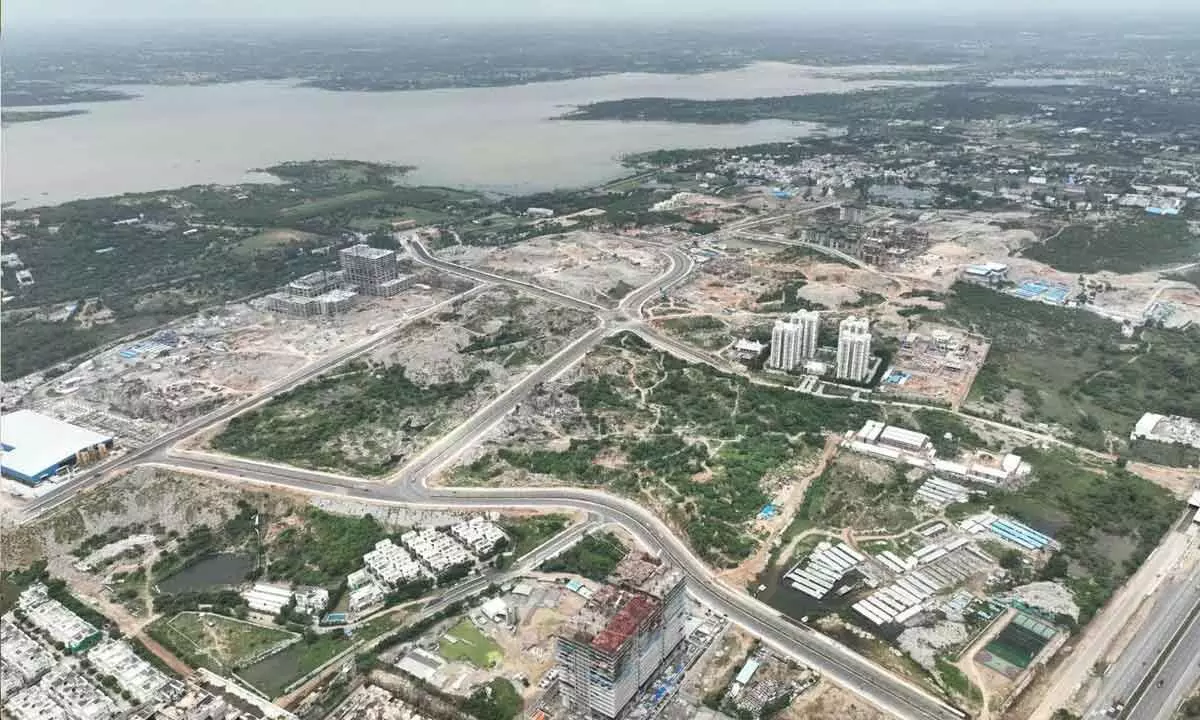
Hyderabad · West
Mokila
Hyderabad’s Premium Low-Density Western Corridor
A strategically positioned western Hyderabad market shaped by villa communities, plotted development, larger land parcels and the continued outward expansion of the metropolitan region.
Our view on Mokila.
Mokila has emerged as one of the more prominent low-density residential markets in western Hyderabad.
Its development has been driven by the westward expansion of Hyderabad's premium residential market, particularly from the Financial District, Gachibowli, Tellapur and Kollur.
Unlike Kokapet, which is increasingly defined by high-density urban development, Mokila retains a more open development character dominated by:
Villas
Gated communities
Residential plots
Larger land parcels
Low-density residential development
This gives Mokila a distinct position within the western corridor.
It is neither an established inner-western suburb nor simply an undeveloped peripheral market.
It is a transitioning residential and land market within Hyderabad's expanding western urban footprint.
Why Mokila Matters
Mokila's importance comes from its position within the broader western development system.
The market sits close to:
Tellapur
Kollur
Osman Nagar
Shankarpally
Gachibowli
Financial District
This creates a natural connection between the established employment centres of western Hyderabad and the lower-density residential markets further west.
Mokila therefore benefits from two different forces:
Demand moving outward from Hyderabad
and
land becoming increasingly organised into residential communities.
The Western Development Continuum
Mokila becomes more meaningful when viewed within the larger western corridor.
Established Employment Core
Financial District
Gachibowli
Nanakramguda
↓
Higher-Density Residential Growth
Kokapet
Narsingi
Tellapur
↓
Emerging Residential Corridor
Kollur
Osman Nagar
Mokila
↓
Lower-Density Western Expansion
Shankarpally
Wider western corridor
Mokila sits close to the point where premium residential development begins transitioning into lower-density suburban expansion.
That is one of its defining characteristics.
Connectivity
Western Hyderabad Connection
Mokila's principal advantage is its road connectivity toward the established western employment corridor.
Routes connect the market toward:
Tellapur
Kollur
Gachibowli
Financial District
Shankarpally
ORR-connected western Hyderabad
However, practical accessibility depends heavily on the exact location of a project or parcel.
WENS therefore evaluates connectivity based on:
actual road access + route quality + travel time + junction conditions
rather than simple straight-line distance.
ORR Access
The Outer Ring Road provides regional connectivity to the wider Hyderabad metropolitan area.
For Mokila residents, ORR access can facilitate travel toward:
Gachibowli
Financial District
Airport
Shamshabad
Northern Hyderabad
Eastern Hyderabad
The benefit is therefore primarily regional.
Mokila should not be presented as an ORR-frontage market; the value of ORR access depends on the actual road connection from each micro-location.
Residential Market
Mokila has developed a distinctive villa and low-density residential identity.
The market is particularly associated with:
Luxury villas
Gated villa communities
Residential plots
Independent homes
Low-density developments
This creates a different buyer profile from the apartment-heavy markets closer to the Financial District.
Demand can come from:
High-income professionals
Business families
Senior corporate executives
NRIs
Families seeking larger homes
Buyers seeking lower-density communities
Investors with longer holding periods
The Villa Market
The villa segment is one of Mokila's strongest defining characteristics.
Large gated communities can offer:
Larger built-up areas
Private open space
Clubhouse facilities
Community amenities
Lower residential density
Premium lifestyle positioning
However, the villa market has a fundamental limitation:
its buyer pool is narrower than the mass apartment market.
This means project selection and pricing discipline are particularly important.
A premium villa community may have strong end-user demand while another project in the same broader corridor may experience much slower absorption.
WENS therefore evaluates villa opportunities at the project level, not simply at the locality level.
Plotted Development
Plotted development remains an important component of Mokila's market.
Plots appeal to buyers who want:
Future self-construction
Larger land ownership
Flexibility of development
Lower-density living
Long-term land exposure
But plotted development also requires a longer view of urbanisation.
A gated layout can be legally approved and still take considerable time to achieve meaningful habitation.
Therefore WENS distinguishes between:
approved development
and
actual urbanisation.
Both matter, but they are not the same thing.
Land Market
Mokila remains relevant from a land perspective because of its larger development parcels and comparatively lower development intensity than the western core.
Potential land-use opportunities can include, where legally permissible:
Residential development
Plotted communities
Villa projects
Larger residential communities
Institutional uses
Strategic land holding
The exact development potential of any parcel depends on its planning and legal status.
Land Due Diligence
Land in and around Mokila should be evaluated carefully for:
Title
Complete ownership chain and title continuity.
Encumbrance
Verification of registered encumbrances and claims.
Survey
Survey number, subdivision, physical boundaries and records.
Land Use
Actual classification and permissible use.
Zoning
Applicable master-plan and development controls.
Access
Legal access to a public road and actual road width.
Layout
Approval status where the property forms part of a proposed or existing layout.
Government Reservations
Potential road widening, reservations, acquisition or other planning requirements.
Utilities
Availability and capacity of electricity, water, drainage and other services.
Surrounding Development
Existing and committed development around the parcel.
For Mokila, the quality of the surrounding development ecosystem is particularly important.
Employment & Demand
Mokila does not have the employment concentration of the Financial District itself.
Its demand is largely derived from the western employment ecosystem.
Financial District and Gachibowli remain important employment anchors.
This creates a commuting relationship:
Employment core → residential expansion → lower-density lifestyle markets
Mokila benefits when higher-income households are willing to trade some commuting distance for:
Larger homes
More open surroundings
Lower density
Gated-community amenities
That makes Mokila particularly relevant to the premium end-user segment.
Development Character
Mokila is fundamentally a low-density suburbanisation market.
Its development pattern is different from the vertical urbanisation of Kokapet.
The emerging pattern is:
Land → plotted development → villas → community infrastructure → habitation → supporting services
This creates a more gradual form of urbanisation.
The market's success therefore depends not just on the number of projects launched, but on whether these projects become functioning residential communities.
Supply & Competition
Mokila operates within a competitive western residential landscape.
Its key competing markets include:
Kollur
Tellapur
Osman Nagar
Shankarpally
Nallagandla
Other villa and plotted-development corridors
This competition gives buyers alternatives.
As a result, Mokila's strongest assets are likely to be those offering a combination of:
Strong location
Reliable developer
Good access
Legal clarity
Quality infrastructure
Community occupancy
Appropriate pricing
Long-term usability
Residential Demand vs Investment Demand
An important characteristic of Mokila is the distinction between end-user demand and investment demand.
A villa or plot may attract investors because of the western Hyderabad growth narrative.
But sustainable market value ultimately depends on genuine end-user demand.
WENS therefore watches:
Who is buying?
Why are they buying?
Are they occupying?
How easily can the asset be resold?
Is rental demand developing?
These questions provide a better picture of market maturity than registration or launch volumes alone.
Infrastructure Status
Operational
Existing western road network
Mokila is connected to Tellapur, Kollur, Shankarpally and the wider western Hyderabad region through established roads.
Outer Ring Road
The ORR provides regional connectivity through the wider Hyderabad metropolitan network, subject to access from the individual micro-location.
Developing
Local urban infrastructure
As residential communities expand, roads, drainage, water supply, electricity and local services continue to develop.
Infrastructure quality can vary significantly between individual developments.
Future / Potential
Future improvements to western Hyderabad's road and public-transport network could strengthen Mokila's integration with the metropolitan region.
WENS does not assign present-day value to an infrastructure project solely because it has been announced.
Infrastructure is classified according to its actual implementation stage.
What WENS Is Watching
1. Villa absorption
Are new villa communities achieving healthy end-user absorption?
2. Community occupancy
Are completed developments becoming functioning neighbourhoods?
3. Plot-to-home conversion
How quickly are plotted developments converting into actual residences?
4. Supporting infrastructure
Are retail, schools, healthcare and daily services following residential growth?
5. Connectivity
How does practical travel time to the western employment core evolve?
6. Land conversion
How quickly are larger parcels being converted into organised developments?
7. Competitive supply
How much new villa and plotted inventory is entering the wider western corridor?
8. Resale liquidity
Can owners exit efficiently, or is the market still primarily dependent on new-project sales?
Key Risks
Mokila's lower-density character creates opportunities, but also specific risks.
Investors and buyers should consider:
Longer urbanisation timelines
Narrower villa buyer pool
Large plotted-development supply
Dependence on western employment centres
Local infrastructure gaps
Limited immediate rental depth in some pockets
Developer execution risk
Legal and approval risk for land
Competition from Kollur and Shankarpally
Over-reliance on future infrastructure narratives
Potentially lower resale liquidity for poorly located projects
The central risk is timing.
A good asset can still require patience if the surrounding market takes longer to mature.
WENS Opportunity Framework
For Mokila, WENS looks for opportunities where:
Location
The asset sits within a credible western growth path.
Access
Actual road connectivity supports practical use.
Legal Clarity
Title, land use, zoning and permissions are sufficiently established.
Development Quality
The project or surrounding development is capable of creating a functioning community.
Demand
There is a credible end-user reason to own or occupy the asset.
Exit
There is a realistic future resale or development pathway.
This approach helps separate genuine opportunity from corridor speculation.
WENS Market View
Mokila is a premium low-density market in transition.
Its opportunity is closely linked to the continued westward expansion of Hyderabad.
The Financial District and Gachibowli provide the economic engine.
Tellapur and Kollur are expanding the residential base.
Mokila offers a lower-density residential environment further along that growth path.
This creates a compelling combination:
western employment + larger homes + lower density + land availability.
But Mokila's future should not be judged solely by how many projects are announced.
The next stage of the market will depend on habitation, infrastructure and genuine end-user demand.
For WENS, the strongest opportunities are therefore not necessarily the newest projects.
They are assets where:
location + legal quality + development quality + pricing + future demand
are aligned.
- Market Type
- Premium Low-Density Residential Market
- Development Stage
- Emerging / Urbanising
- Primary Driver
- Western Hyderabad Residential Expansion
- Secondary Driver
- Proximity to Tellapur–Kollur–Shankarpally Corridor
- Dominant Asset
- Villas, Plots & Low-Density Communities
- Land Opportunity
- Selective
- Residential Opportunity
- Moderate to Strong
- Rental Depth
- Developing
- Speculative Risk
- Moderate
- WENS Outlook
- Positive for well-located, legally clear and end-user-oriented opportunities
A premium low-density western market where Hyderabad's urban expansion meets the demand for larger homes, gated communities and strategic land.
Market conditions, infrastructure, development activity, land values and property values change over time.
WENS market views are research and intelligence-based assessments and should not be interpreted as guarantees of future returns.
Property-specific decisions should be supported by independent legal, technical, financial and regulatory due diligence.
Infrastructure has been classified separately as operational, developing, approved/planned or future/potential wherever relevant.
Last reviewed: September 2026
Thinking about Mokila?
We will tell you what has transacted there recently and what we would pay today.